

Deploy openYuanrong Cluster on K8s#
This section introduces how to deploy openYuanrong cluster on Kubernetes.
Overview#
openYuanrong cluster consists of master node pods and worker node pods.
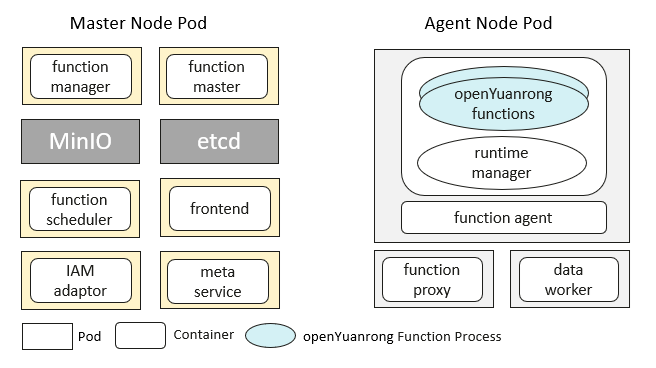
For deployment, refer to User Guide, which contains more content including configuration item introduction, security, cluster operations and maintenance, etc.
Master Node Pod#
Master node pod is used to manage the cluster, responsible for global function scheduling, request forwarding, etc. Components include function master, function manager, function scheduler, frontend, meta service, IAM adaptor, and open source MinIO, etcd.
Worker Node Pod#
Worker node pods run distributed tasks. They include function agent, function proxy, runtime manager, and data worker, which is enabled by default but can be disabled.
Component Introduction#
function master
Responsible for topology management, global function scheduling, function instance lifecycle management, and scaling of function agent component. Deployment form is Deployment, one master with multiple backups.
function manager
Responsible for lease application and recycling, cleaning up expired connection information. It is an openYuanrong system function.
function scheduler
Responsible for function service scheduling. It is an openYuanrong system function.
frontend
Provides REST API for calling services, subscribing to stream services and other data processing. It is an openYuanrong system function.
meta service
Provides REST API for management operations such as function creation, resource pool creation, etc. Deployment form is Deployment.
IAM adaptor
Responsible for multi-tenant authentication and authorization. Deployment form is Deployment, one master with multiple backups. If there are no related requirements or there is already an authentication platform, deployment is not required.
etcd
Third-party open source component used to store cluster component registration information, function metadata, and instance status information.
MinIO
Third-party open source component used to store function code packages uploaded by users, deployment is optional.
function proxy
Responsible for message forwarding, local function scheduling, and instance lifecycle management. Deployment form is DaemonSet.
function agent
Minimum resource unit, responsible for function code package download and decompression, network security isolation configuration, etc. Deployment form is Deployment, it is in the same pod with runtime manager.
runtime manager
Responsible for cpu, memory and other resource collection and reporting, function process lifecycle management, etc. Deployment form is Deployment, it is in the same pod with function agent.
data worker
Provides data object storage and related capabilities. It is deployed as a DaemonSet by default and can be disabled as described in Optional DataSystem Deployment when only direct invoke is required.
Pod Resource Pool#
Pod resource pool is used to run function instances, theoretically based on K8s Deployment workload implementation, including function agent and function manager two container images. According to your actual business function needs, you can configure Pod resource pool’s CPU, memory, replica count and other information during deployment, or dynamically create through Resource Pool Management API after deployment.